
The following document is the U.S. Government’s appellee brief in Luke Wenke’s 2025 appeal case (#25-1165). In it, the government asks the Second Circuit Court of Appeals to uphold the district court’s April 2025 decision ordering Luke Wenke to undergo involuntary inpatient mental health treatment.
The document notes that Wenke originally pleaded guilty to a federal cyberstalking charge, received 18 months in prison and three years of supervised release, then later violated supervised release twice. After the second violation, the district court ordered mental health evaluations.
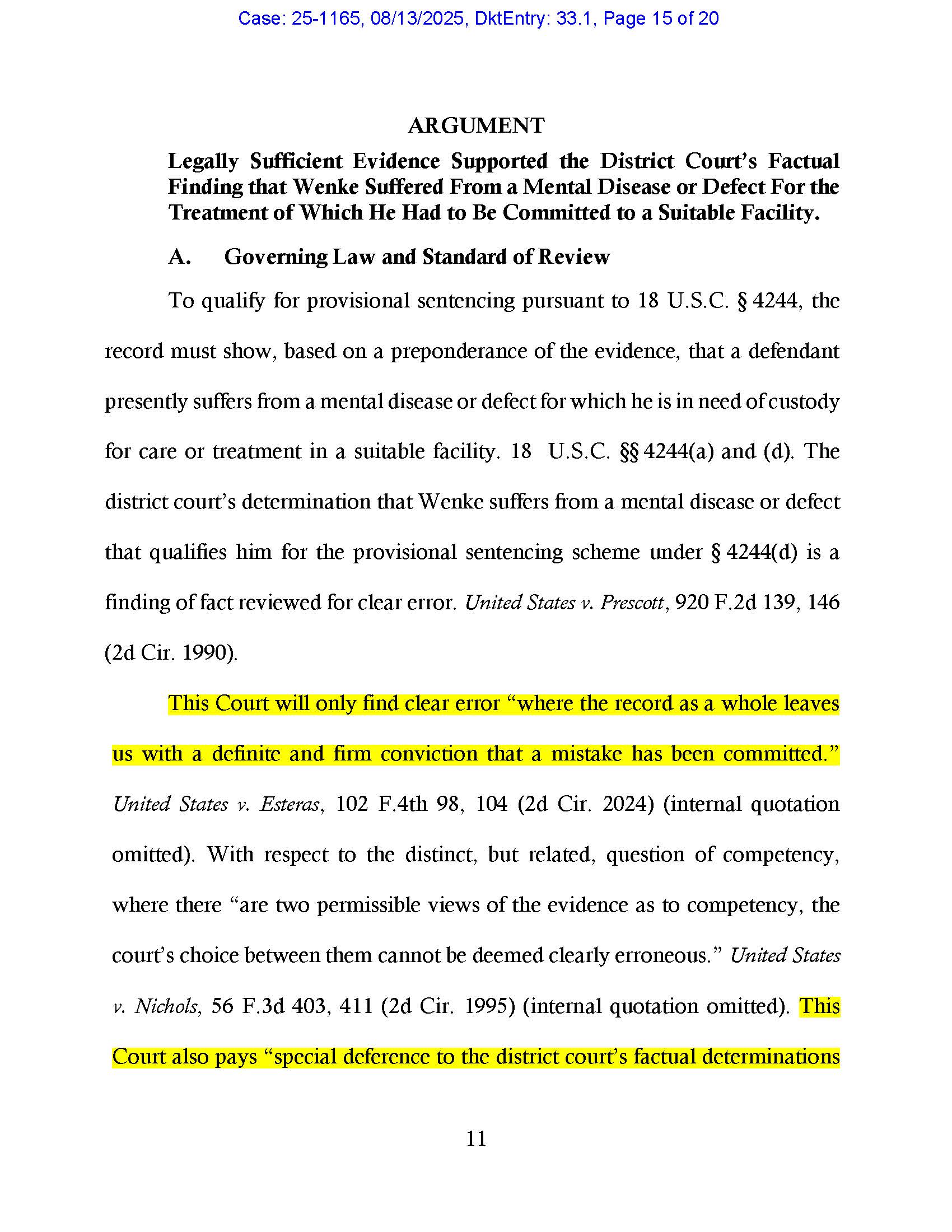
The central issue is not whether Wenke was competent. The court found he was competent, but ordered a hearing to determine whether he was suffering from a mental disease or defect that required treatment in a suitable facility under 18 U.S.C. § 4244.
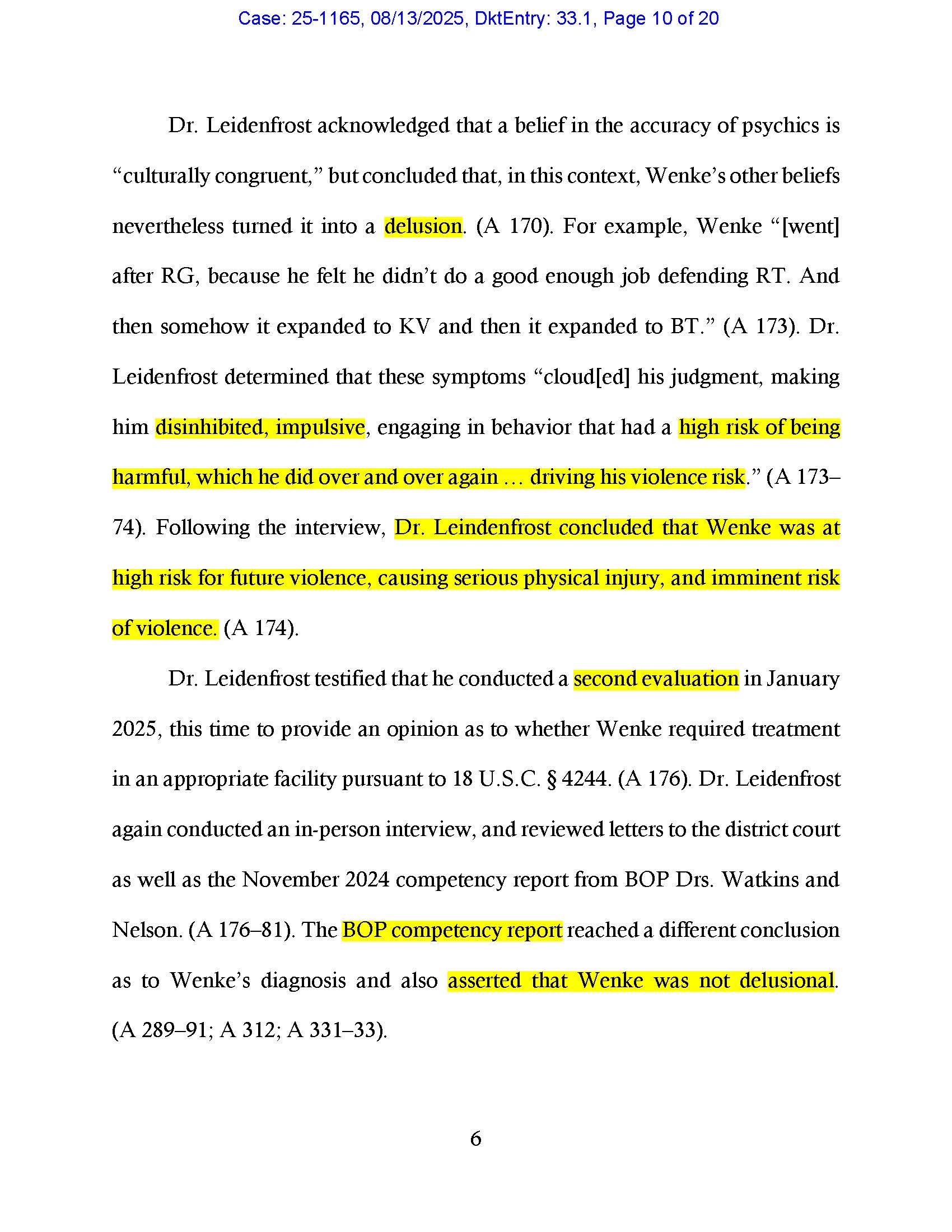
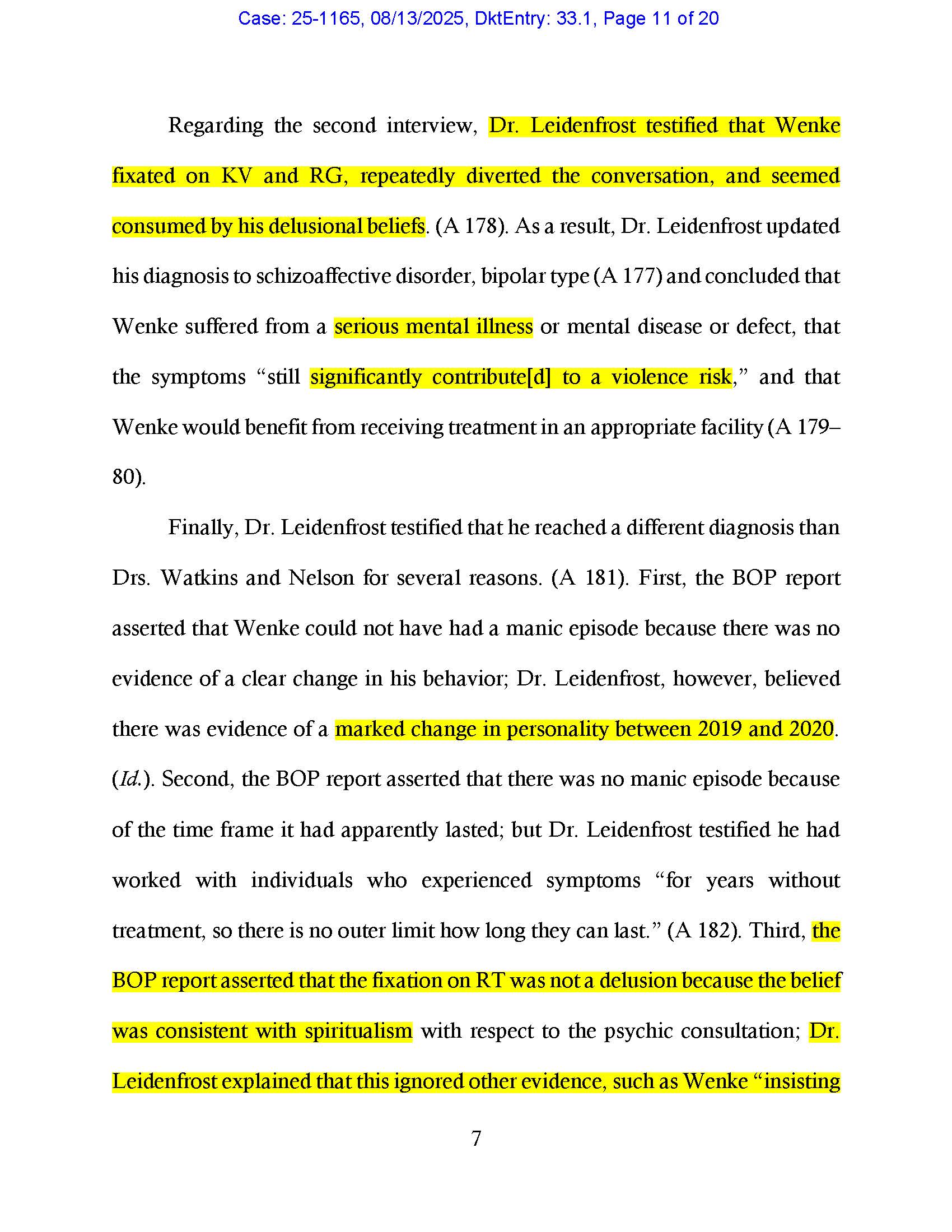
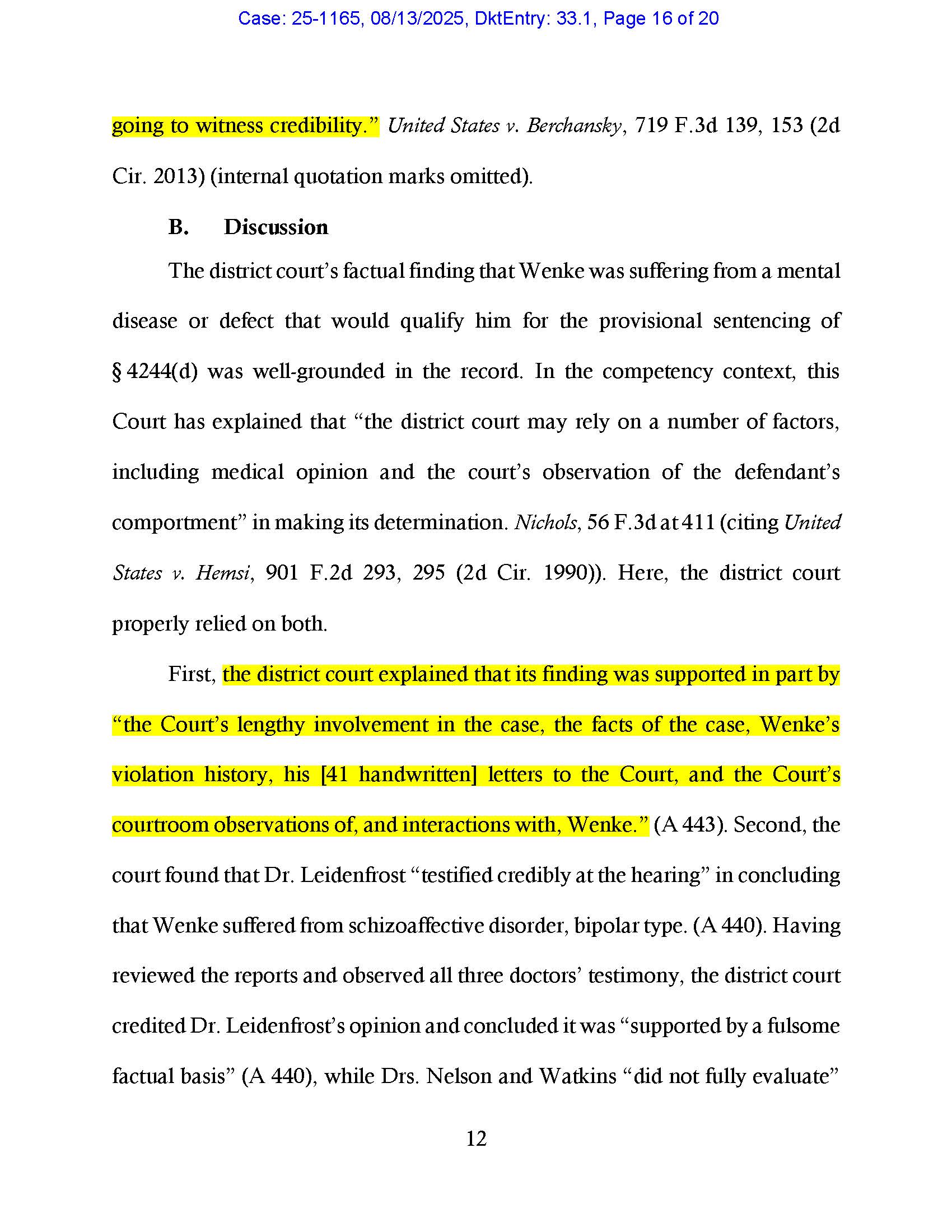
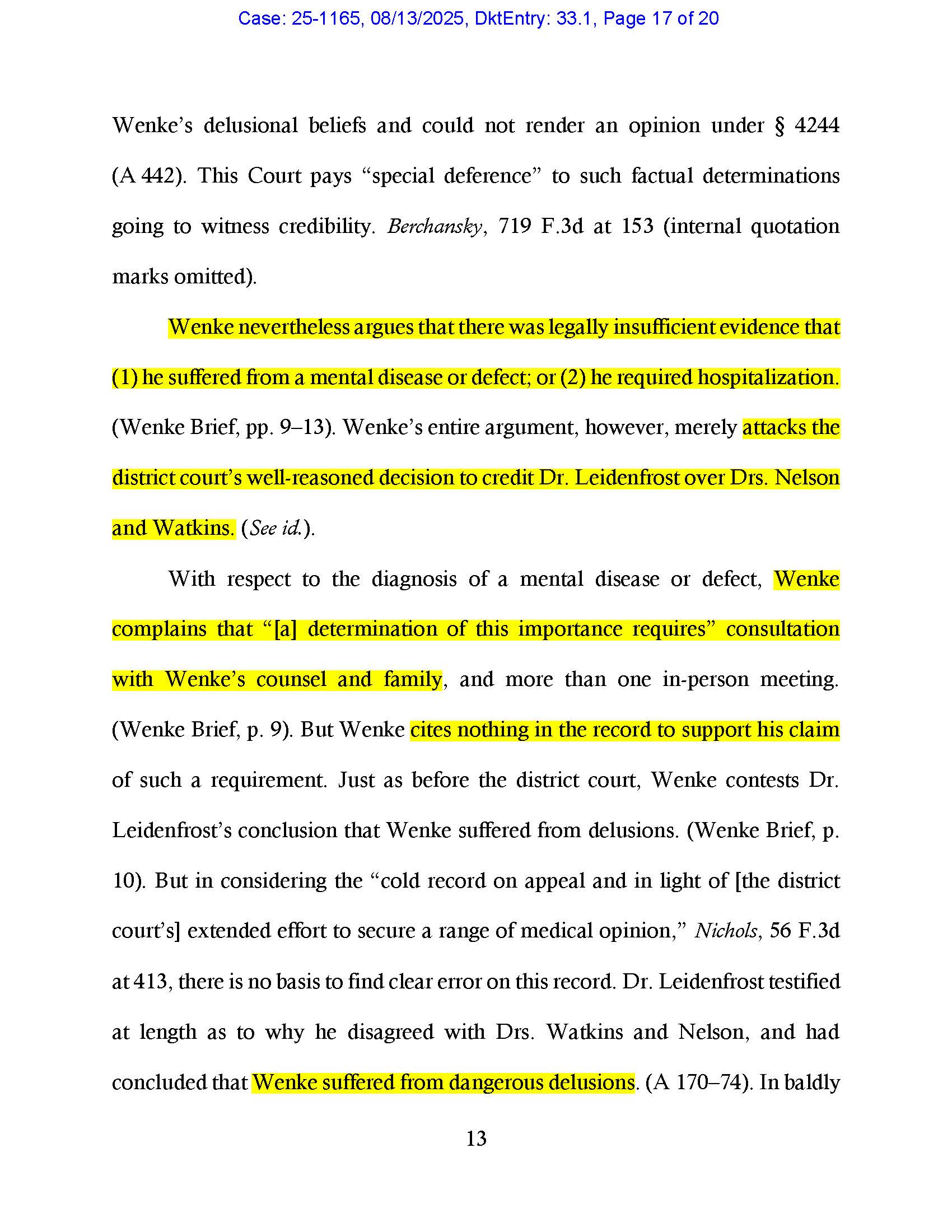
The government argues that the district court had enough evidence to commit Wenke because one evaluator, Dr. Corey Leidenfrost, testified that Wenke had serious delusional beliefs, fixation on certain people, impaired judgment, and elevated violence risk. More specifically, Leidenfrost refuted the notion that Wenke’s reliance on psychics transcended the realm of cultural congruenc (i.e. a tradition he was brought up with and that many people believe in) and qualified as a form of delusional thinking.
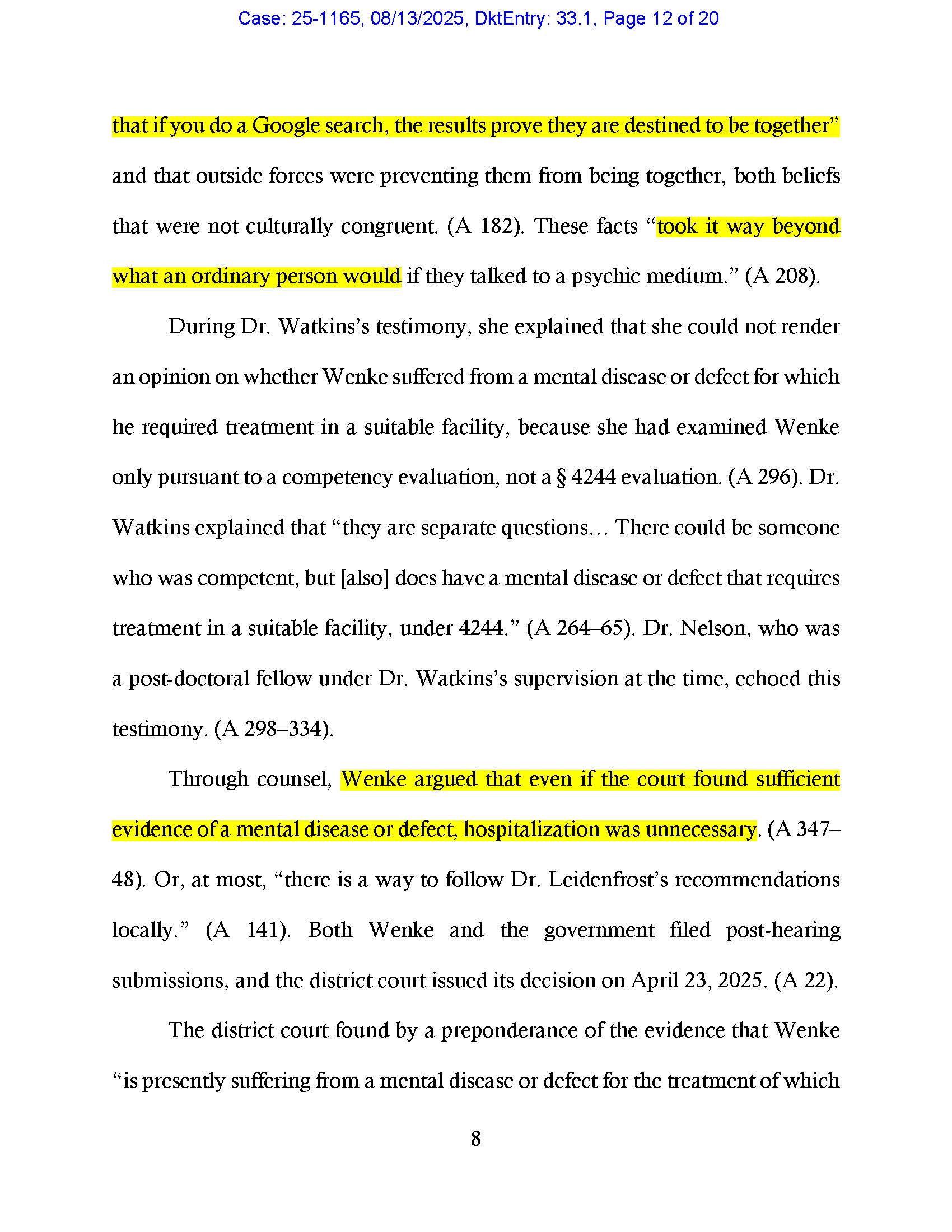
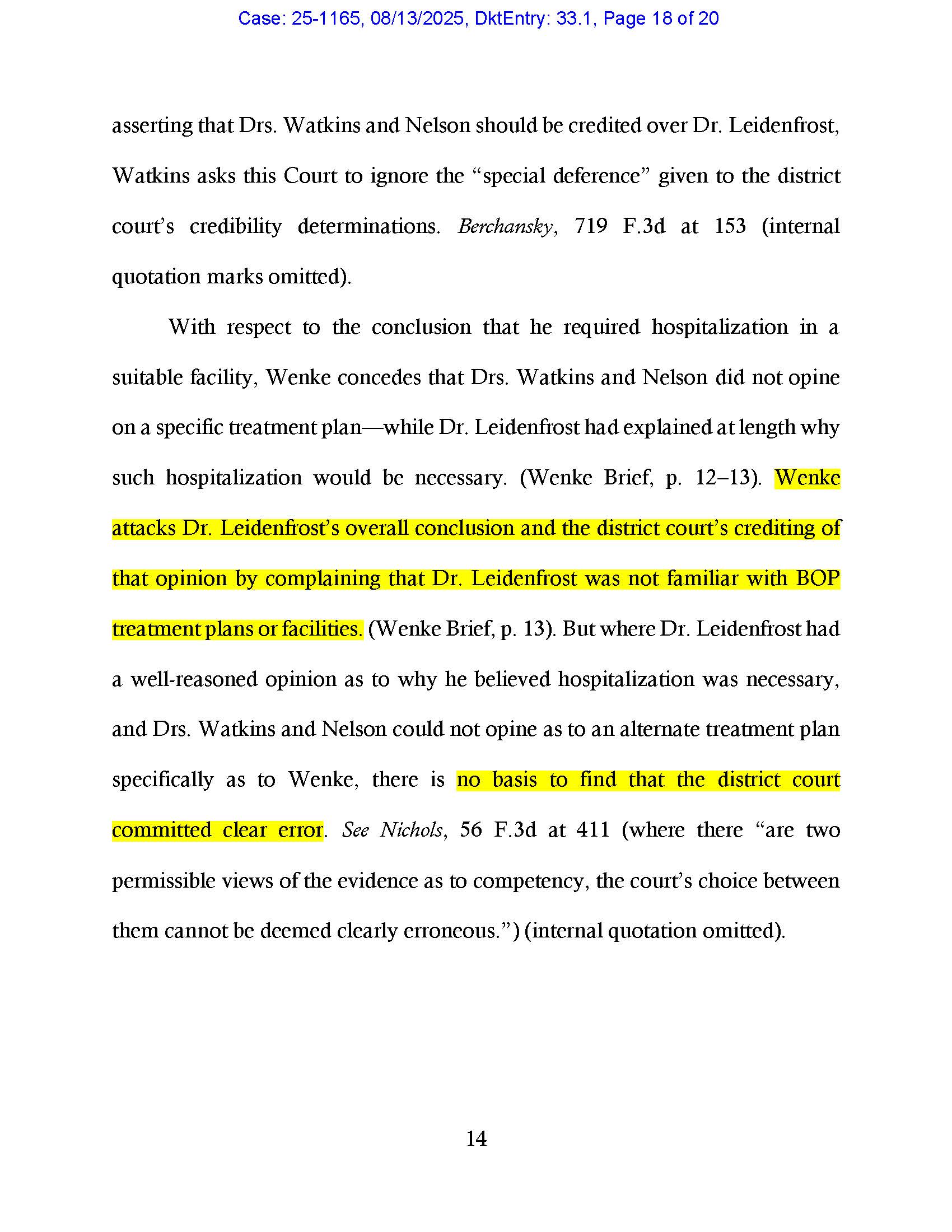
U.S. Bureau of Prisons forensic psychologists Dr. Robin Watkins and Dr. Kaitlyn Nelson found Wenke competent but did not fully answer the § 4244 treatment/commitment question because they admittedly did not perform the proper evaluation to determine whether Wenke needed forced hospitalization. Watkins and Nelson argued that Wenke was not delusional, and that his belief in psychics was “culturally congruent” and in accordance with his family’s traditions.
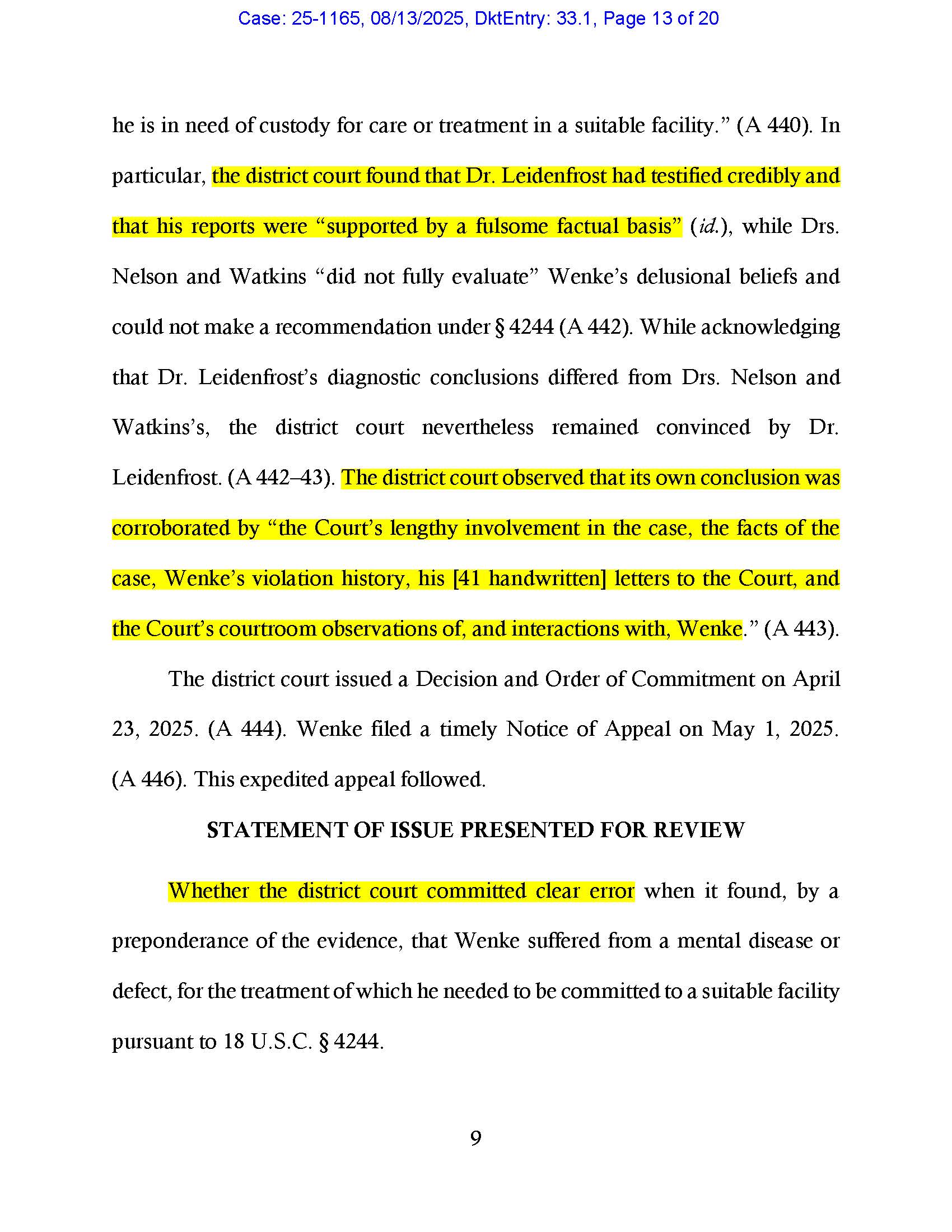
The government’s main legal point is that appeals courts give strong deference to trial judges on factual findings and witness credibility. In other words, because the district judge heard the doctors, reviewed the reports, observed Wenke, and explained the ruling, the government says there was no clear error.
Bottom line: the government says the commitment order should be affirmed in full. And that’s exactly what the Appeals court did in September 2025 when it denied Wenke’s motion. This meant that Wenke would continue to undergo mandatory inpatient treatment at a federal medical prison in Massachusetts until he served the maximum sentence for his probation violation convictions, which was two years. With credit for time served, that meant that he would be released less than a month after the appeals court issued the denial.
USA v. Luke Wenke Appeal | Appellee Brief
August 13th, 2025
Case #1:22-cr-00035, Document #33
Categories: Luke Wenke, court documents: appeals: 2025 appeal; competency, obsessions: Katie obsession, letter writing obsession, Ryan/Benjamin obsession
Tags: Buffalo, NY; case law, conditions of supervised release, Dr. Corey Leidenfrost, contact ban violations, cyberstalking, dangerousness, delusions of grandeur, denial of mental illness, erotomania/romantic delusions, involuntary commitment, Dr. Kaitlyn Nelson, U.S. Attorney Michael DiGiacomo, persecutory delusions, probation violations, psychiatric/psychological evaluations, resistance to mental health treatment, Dr. Robin Watkins, U.S. Bureau of Prisons, violations of supervised release